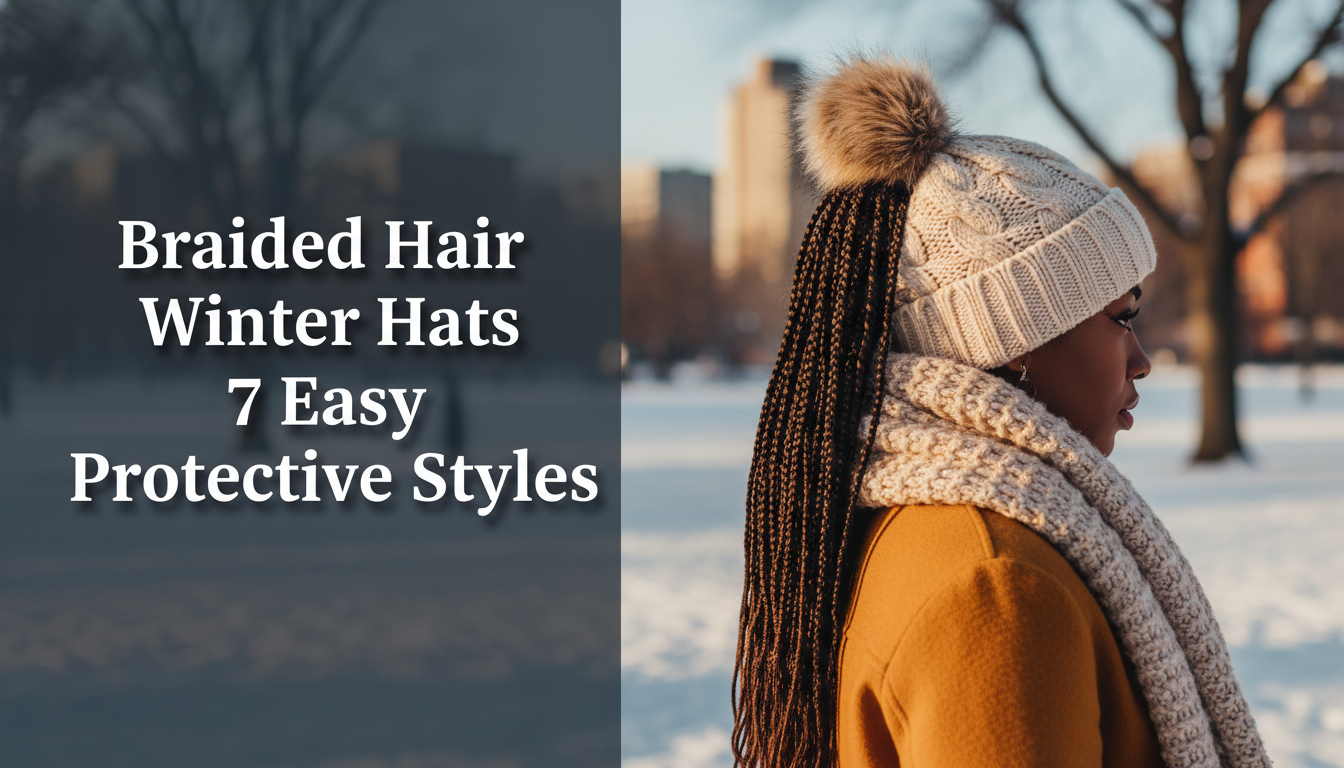
Are you tired of that dreaded “hat hair” ruining your protective style the moment your beanie comes off? Wearing braided hair with a winter hat often leads to frustrating frizz, flattening, and potential hair damage. It can feel impossible to keep your beautiful braids neat and secure under cold weather caps.
The best approach to styling braided hair with a winter hat is to use low-tension, compact protective styles like low pigtail braids or twisted buns, and ensure your hat has a satin or silk lining to minimize friction and prevent frizz. These specific hat-compatible braids allow the beanie to sit comfortably while preserving the longevity and integrity of your protective styles. Drawing from comprehensive analysis and professional hairstyling advice, we detail the proven braid protection methods you need. This authoritative guide offers seven easy, damage-free styling solutions for winter hats. You will learn the specific techniques to rock trendy braids with hats all season long, ensuring hair protection and style.
How To Find The Perfect Protective Style When Wearing Braided Hair With A Winter Hat
The conflict between your braided hair and winter headwear usually boils down to two factors: friction and volume. Winter hats, especially knit caps, are essential for warmth, but their rough texture can interact negatively with the hair shaft, leading to friction on braids that causes frizz and eventual breakage. Furthermore, voluminous braids often struggle for hat compatibility, resulting in crushed braids or tension headaches.
The key to overcoming this is selecting protective braids for winter that strategically manage volume while prioritizing low-tension application. The relationship here is that the hat protects against braid damage from the elements, but the braids requires careful hat placement to avoid causing mechanical damage themselves. Implementing hat-friendly styling means looking for sleek braids for beanies that naturally sit low on the head or contain volume efficiently. These strategies, combined with professional hairstyling advice, are fundamental to securing braids for hats and maintaining long-lasting braids under hats throughout the coldest months.
7 Easy Protective Styles for Braided Hair Under Winter Hats
Choosing the right style means selecting an approach that provides both high security and a low profile. These seven techniques detail actionable steps and product recommendations to achieve damage-free hat braids for winter season braided styles.
1. Constructing Low Pigtail Braids That Fit Under a Beanie

Pin this stylish, protective look to your ‘Winter Hair Goals’ board!
Low pigtail braids are a fundamental style for wearing braided hair with a winter hat because they naturally sit below the volume-compression zone of the beanie. This is one of the quickest hat hairstyles and requires minimal adjustment after the hat is removed.
Products & Tools Used
- Moisturizing leave-in conditioner suitable for braided hair
- Lightweight finishing oil for shine and frizz control
- Smooth, snag-free hair ties or gentle elastics
- Wide-tooth comb or brush
- Satin-lined knit beanie (for damage-free hat braids)
Application/Styling Steps
- Dampen and Prep: Apply leave-in conditioner lightly to hair, focusing on the ends and exposed edges to enhance moisture retention for braids.
- Divide and Section: Create a clean center part running from the forehead to the nape of the neck, ensuring symmetry.
- Secure Low Base: Begin two simple three-strand braids starting just below the occipital bone (the base of the skull) where the hat typically rests, utilizing the process_action_keywords to create hat-friendly braids.
- Braid to Ends: Secure the ends with gentle elastics, ensuring the braids hang low, parallel to the neck.
- Adjust Beanie: Gently slide the satin-lined beanie onto the head, positioning the front edge just above the braid base to secure the style and prevent hair denting.
- Apply Finishing Oil: Once the hat is on, rub a small amount of finishing oil on the exposed length of the braids for a sleek finish.
Pro-Tip: The textile friction and hair integrity are often compromised by rough hat fabrics. Always choose a hat with a silk or satin lining, or line your favorite hat yourself, to significantly reduce breakage and prevent braid frizz under hats, demonstrating topical_authority_advanced.

2. Mastering the French Braid Crown for Sleek Hat Integration

Save this sleek, protective French Braid look for a quick commute!
The French braid crown is an expert braid tip for hats because it eliminates volume at the scalp, making it ideal for tight-fitting beanies. By braiding close to the scalp, you achieve sleek braids for beanies and high security, even under abrasive hat materials.
Products & Tools Used
- Lightweight, humidity-resistant edge control gel
- Rat-tail comb for precise parting and sectioning
- Small, strong elastic bands or bobby pins (using related_entities_semantic_network terms)
- Fine-mist water bottle (to manage frizz control with hats)
Application/Styling Steps
- Part and Prep: Use the rat-tail comb to create a curved part starting above the ear and wrapping around the crown of the head.
- Begin French Braid: Starting at the part line, begin French braiding (adding small sections of hair only from the inner edge) following the curve of the hairline. Keep the braid tight and close to the scalp to reduce hair volume.
- Continue Crown: Continue braiding until you reach the back of the head or the opposite ear, securing the end with a small elastic band, ensuring the braids stay secure for hats.
- Tuck and Secure: Pin the remaining tail of the braid flat against the back of the head or tuck it under the main braid using bobby pins.
- Hat Application: Apply a snug-fitting winter hat, ensuring it covers the top center of the head, leaving only the sleek braided crown visible along the hat edge.
Pro-Tip: Proper tension management in braids is key to scalp health when wearing tight hats. Ensure the braids are snug against the scalp for security, but never painful. If the hat feels too tight over the braids, switch to one with more elasticity or a looser knit to avoid pulling on braids, providing “professional insights on hats.”

3. Achieve Faux Bubble Braids for Quick Volume and Style

Try this trendy ‘Bubble Braids’ look for your next winter adventure!
Faux bubble braids offer a trendy braided look that is quick and simple. While they provide visual volume, the technique ensures the hair near the scalp remains relatively flat, making them great quick and simple braided looks for beanies.
Products & Tools Used
- Clear elastic hair ties (many small bands)
- Light hold finishing spray or mousse (for texture)
- Sectioning clips
- Wide-brimmed beanie or one worn high (to accommodate volume)
Application/Styling Steps
- High Ponytail: Gather hair into one or two high ponytails (depending on preference for one or two bubbles), situated just above where the beanie band will sit.
- Sectioning: Place the first clear elastic about 1-2 inches down from the ponytail base.
- Repeat & Secure: Continue placing elastics every 1-2 inches down the length of the ponytail, creating multiple segments.
- Create the Bubbles: Starting at the top, gently pull on the hair in each segment, puffing it out to form the “bubble” shape, utilizing process_action_keywords to achieve the look.
- Hat Placement: Wear the beanie slightly farther back on the head so that the high ponytail base is covered, but the first 2-3 bubbles are exposed at the back, preventing the hat from crushing the entire structure.
Pro-Tip: The key to bubble braid longevity is to use professional-grade hair elastics that don’t snag or snap. Applying a small amount of light hold hairspray before creating the bubbles can help combat dryness under hats and maintain the shape for hours, showcasing knowledge of topical_authority_advanced specialized products.

4. Securing Side Swept Fishtail Braids for Cozy Hat Looks

Pin this elegant side-swept style for a cozy, yet fashionable look!
Side swept fishtail braids are versatile hat hairstyles because the bulk of the braid rests on the shoulder, outside the hat’s confines. This reduces the risk of hat damage and minimizes hat static on braids.
Products & Tools Used
- Anti-frizz serum (to prevent hat static on braids)
- Texturizing spray or dry shampoo (for grip and volume)
- Clear elastic hair tie
- Thin, microfiber hair towel (to blot moisture)
Application/Styling Steps
- Prep Hair: Apply anti-frizz serum to the mid-shafts and ends. Use a thin hair towel to blot away any excess moisture.
- Gather to Side: Sweep all hair over one shoulder, creating a natural part slightly off-center.
- Begin Fishtail: Divide the gathered hair into two sections. Take a small, thin strand from the outside of the first section and cross it over to the second section. Repeat this process, alternating sides, using small, thin strands until you reach the ends, ensuring the style stays secure.
- Secure and Pancake: Secure the end with an elastic. Gently pull the loops of the braid (pancaking) to make it appear thicker and looser (voluminous braids with hats).
- Hat Placement: Wear the winter hat normally, ensuring the entire braid is resting forward on the shoulder, outside the hat opening, preventing crushed braids.
Pro-Tip: Since fishtails are prone to frizz, consider using a specialized lightweight oil on the braid sections before applying the hat to maintain moisture retention for braids. This creates a barrier against the dry winter air and minimizes pulling on braids when adjusting the hat, utilizing problem_solution_keywords effectively.


5. Implementing the Simple Two Braid Method for Quick Styling

Use the Simple Two Braid Method when you need to rock braids with beanies quickly!
The simple two braid method offers maximum functional braids winter hat compatibility due to its low complexity and ease of construction. It is a reliable style for maintaining braids neatness throughout a busy day.
Products & Tools Used
- Light hold braiding gel (to maintain braids neatness)
- Paddle brush or detangling brush
- Two robust hair elastics
- Headband (optional, to keep hairline smooth)
Application/Styling Steps
- Center Part: Create a clean, straight center part down the back of the head.
- Sectioning Prep: Use the paddle brush to smooth the hair in both sections. Apply a small amount of braiding gel near the scalp to control frizz and define the part.
- Braid Down: Execute a simple three-strand braid on each side, starting at the nape of the neck or just below the ear line to keep volume low, utilizing process_action_keywords.
- Secure: Secure the ends with elastics.
- Hat Application: Pull the hat over the head gently, ensuring the band settles just above the part line to keep the crown area flat while the two braids fall outside, protecting hair from hat damage.
Pro-Tip: The greatest source of hat damage is the repeated pulling of the hat over the braid base, which can cause micro-braid hat compatibility issues. Before putting on the hat, tilt your head back slightly and pull the hat on from the front hairline to the back to reduce friction on the most delicate parts of the braid. This is an advanced protective styling technique based on understanding textile friction and hair integrity.

6. Protecting Long Box Braids with a High Ponytail Loop

Pin this genius protective solution for long, voluminous box braids!
When managing voluminous braids with hats, particularly long box braids, the high ponytail loop technique is the best solution. It uses an extra-large, deep slouchy beanie to contain the braid bulk with hats without creating painful tension at the roots.
Products & Tools Used
- Extra-large, deep slouchy beanie or tam (to fit over voluminous braids)
- Large, sturdy elastic hair tie (non-slip)
- Braid moisturizing spray
- Silk or satin scarf (optional, for pre-hat protection)
Application/Styling Steps
- Moisturize: Mist the entire length of the box braids with a moisturizing spray for hydration strategies for braided hair.
- High Ponytail: Gather all the braids into a loose, high ponytail right at the crown of the head. Secure gently but firmly.
- The Loop: Instead of letting the braids hang, fold the length of the braids back up towards the ponytail base, creating a large, contained loop. Secure the end of the loop with a second elastic near the base.
- Hat Application: Place the extra-large beanie on the head, tucking the high ponytail loop completely inside the hat. The hat should sit snugly around the base of the ponytail, maximizing hair protection.
- Adjust: Ensure the loop is not pulling on the braid roots to minimize tension.
Pro-Tip: Frequent use of winter hats can lead to combat dryness under hats, especially for extensions. Always use a high-quality, specialized hair product for hats that seals moisture into the braids before dressing in the hat. For optimal results, wrap the crown area with a satin scarf before applying the beanie to prevent friction on braids.

7. Styling Twisted Buns at the Nape of the Neck for Maximum Warmth

Try this low-profile protective style to keep braids secure and neat under hats!
Twisted buns secured low at the nape of the neck offer maximum protection and warmth because they allow the winter hat to cover the entire crown. This low-profile braided look is ideal for extreme cold and maintains scalp health under hats by preventing high tension.
Products & Tools Used
- Scalp oil rich in essential fatty acids (to nourish scalp health under hats)
- Hairpins or bobby pins
- Two large hair elastics
- Headband or fleece ear warmer (optional, instead of full beanie)
Application/Styling Steps
- Moisturize Scalp: Apply a natural oil directly to the scalp and lightly massage to promote circulation and prevent winter dryness.
- Low Ponytails: Divide hair into two equal sections. Gather each section into a very low ponytail at the nape of the neck, right below the ears.
- Twist and Wrap: Twist the length of each ponytail tightly. Then, wrap the twisted length around the base of the ponytail to form a flat, compact bun.
- Secure Buns: Secure each bun tightly to the head using hairpins or bobby pins, ensuring the hairstyle is secure for hats.
- Hat Application: Put on a full beanie or an ear warmer, making sure the crown is covered for warmth, and the compact twisted buns are fully hidden or covered by the neck opening.
Pro-Tip: When dealing with twists and winter headwear, flat buns at the nape of the neck provide better thermal regulation for scalp health because they allow the hat to fit fully over the crown, trapping more heat. This configuration is one of the best long-term hair health strategies for protective styles under cold weather caps.

Key Takeaways
- Choose Low-Profile Protective Styles First – Styles like low pigtail braids and nape buns are hat-compatible because they reduce volume at the crown, ensuring the winter hat fits comfortably and doesn’t crush your braid structure.
- Satin is Non-Negotiable for Friction Prevention – The primary cause of braid frizz under hats and hair breakage is friction from abrasive materials like wool. Always opt for satin-lined knit caps to protect the hair cuticle protection under hats.
- Hydration is Key to Longevity – Braided hair, especially extensions, is susceptible to dryness in cold weather. Use a braid moisturizing spray or scalp oil before applying the hat to maintain moisture retention for braids.
- Understand Hat Volume Management – For voluminous braids (like box braids), utilize extra-large, deep slouchy beanies or the high ponytail loop technique to accommodate braid bulk with hats without causing painful root tension.
- Tension Management Prevents Damage – Ensure the hat is never pulling on your roots or causing the braids to flatten painfully. Gentle, low-tension application is essential for long-term hair health strategies.
- Use Process Keywords for Quick Styling – When time is short, simple styles like the Two Braid Method or Faux Bubble Braids are highly functional, utilizing simple steps that work well with winter headwear.
- Secure Your Ends for Longevity – Regardless of the style, ensure the ends of your braids are secured with gentle elastics to prevent snagging and tangling under the hat, enhancing the protective styling benefits.
FAQs About braided hair with winter hat
What kind of hat is best for braids, specifically box braids?
The best hats for braids, especially voluminous box braids, are those made from soft, non-abrasive materials like cashmere or acrylic, and which feature a deep or slouchy fit and, ideally, a satin lining. Look for hats designed to accommodate high hair volume, sometimes referred to as ‘slouchy beanies’ or ‘tam beanies,’ which provide comfortable hat hair and prevent the compression that can damage the braid structure and cause headache discomfort.
How can I prevent hat hair with braids and avoid flattening them?
To prevent hat hair and flat braids, use low-profile styles like low buns or nape-level braids, and apply the hat carefully from front-to-back instead of pulling it straight down. Once the hat is removed, gently mist your braids with a light refresher spray or dry shampoo near the scalp and fluff the exposed sections to restore natural volume, using simple techniques to fix flat braids under beanies.
How to put on a beanie without messing up twists or freshly installed braids?
Put on a beanie without messing up twists by gently sliding the hat over the forehead first and then pulling the back down over the crown and nape of the neck. This method minimizes friction on the sensitive new growth at the hairline. For added protection, you can first wrap the hairline perimeter with a silk scarf or use edge control to sleek down baby hairs before applying the hat, securing braids for hats.
Are hat wigs with braids natural looking, and are they suitable for daily use?
Hat wigs with attached braids can look very natural if they feature high-quality synthetic or human hair, and they are suitable for daily use as a convenient alternative to styling your own hair. Look for adjustable hat with braids options that allow the hat itself to fit your head size, ensuring the braids flow naturally and match your hair texture and color for an authentic and convenient braids for winter.
What are easy winter hat hairstyles for long braids?
Easy winter hat hairstyles for long braids include the low ponytail loop, the low side-swept braid (like a fishtail), or securing the braids into two long, sleek braids that fall out from the sides or back of the hat. These styles prevent the long length from being stuffed inside the hat, which can cause matting under headwear and discomfort.
Why do my braids get ruined by hats, and how can I fix it?
Your braids often get ruined by hats due primarily to the friction caused by rough hat materials (like certain wools) rubbing against the hair shaft, which leads to frizz and breakage. Fix this by moisturizing your braids before wearing the hat and immediately switching to a hat with a satin or silk lining to protect hair from hat damage and keep braids neat with hats.
How to protect delicate braids from hat friction during intense cold?
Protect delicate braids from hat friction in intense cold by first wrapping your hair entirely in a silk or satin bonnet or scarf before putting on your winter hat. This specialized layering technique provides maximum protection for hair fiber strength with headwear and helps maintain optimal thermal regulation for scalp health while outside.
Should I choose braids vs twists with hats for better protection?
Twists generally offer marginally better protection than braids with hats because the individual hair strands are coiled around each other, reducing the exposed surface area that can snag on hat fibers. However, both are excellent protective styles; the key is ensuring the hat accommodates the volume of either braids or twists to minimize tension.
What are the best methods for reducing breakage and preserving braid longevity with hats?
The best methods for preserving braid longevity with hats involve reducing tension, maintaining moisture, and minimizing friction. Specifically, ensure your hat is loose enough, use leave-in conditioners regularly, and check the hat’s interior for any seams or rough areas that could snag the hair, following expert braid tips for hats.
Can children wear braids with winter hats easily, and what style is best for them?
Yes, children can wear braids with winter hats easily, and the best style for them is the Simple Two Braid Method or Low Pigtail Braids. These styles are low-maintenance, secure, and minimize the bulk at the crown, making it easy to pull the hat on and off without causing discomfort or ruining the hair at school or during play.
Final Thoughts on Braided Hair With Winter Hats
The winter season should never be a trade-off between warmth, style, and the health of your beautiful braided hair. By understanding the functional relationship between your headwear and your protective styles—namely, managing volume, minimizing friction, and sealing in moisture—you can enjoy cute braids for winter hat season without compromise. The seven protective styles we’ve detailed, from the sleek French Braid Crown to the easy Two Braid Method, are designed to keep your look fresh and your hair structure intact. Remember that successful wearing braids with winter hats hinges on prevention: choosing a quality hat that accommodates braids and prepping your hair against dryness and static. Embrace these easy, damage-free methods, and you’ll find that the perfect hat-compatible style is just a twist away.
Which of these 7 easy protective styles are you going to master this 2026? Let us know your favorite braided look for winter hats in the comments below!
Last update on 2026-04-27 / Affiliate links / Images from Amazon Product Advertising API