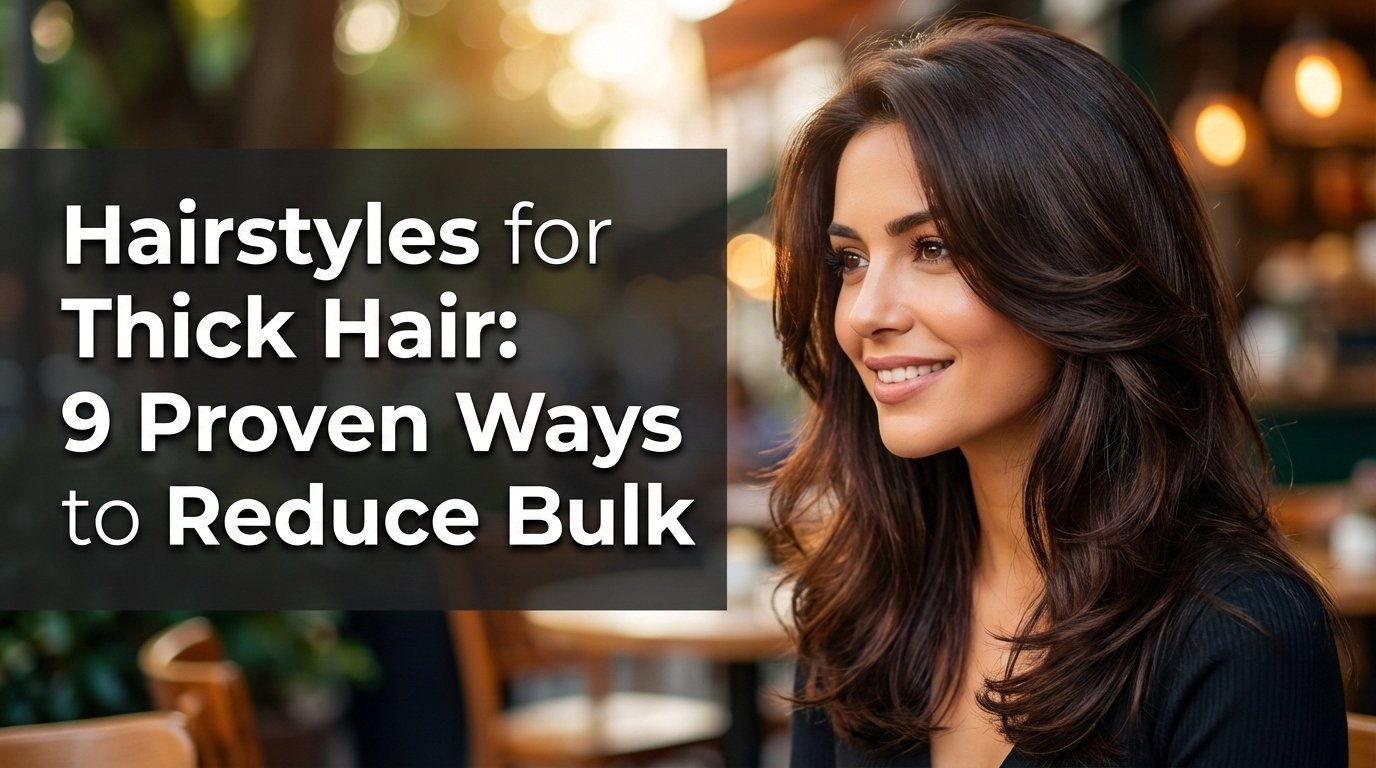
Does it feel like your hairstyles for thick hair have a mind of their own every morning? You aren’t alone if you struggle with heavy hair that refuses to cooperate, turning your daily routine into a battle against bulk. This common frustration often leaves many searching for effective ways to tame their unruly hair.
Managing thick hair often involves strategic cutting and styling to reduce excessive bulk, enhance movement, and minimize frizz, transforming it from a challenge into an asset. This transformation is best achieved through proven techniques like internal layering, precision texturizing, and careful product selection that target the specific density of your hair strands.
Drawing from comprehensive analysis of expert hair advice and proven styling methodologies in 2026, we provide verified solutions for dense hair types. You will discover 9 actionable strategies to significantly reduce weight and gain control over your style. Get ready to finally love your thick hair with these practical steps.
Your Ultimate Guide to Managing Thick Hair: 9 Proven Ways to Reduce Bulk
Finding the right balance when you manage thick hair requires more than just a good haircut; it demands a holistic approach to styling and maintenance. The primary challenge with thick hair lies in its density and weight, which can make even simple styles feel overwhelming and heavy. To effectively reduce bulk, we need to look at specific hairstyles and cutting techniques that physically alter how the hair sits and moves. This involves understanding the relationship between your hair’s texture—whether it is thick wavy hair or thick straight hair—and the tools used to shape it.
By implementing specific strategies, you can transform voluminous hair from a burden into a stunning feature. The following sections detail nine proven methods, ranging from structural changes like layers and undercuts to daily management techniques using braids and products. Each method is designed to address the core attributes of heavy hair, offering you practical ways to style thick hair with ease. Whether you are looking for a drastic change or a simple styling tweak, these expert-approved solutions provide the roadmap to lighter, more manageable thick hair.
1. Strategically Layer Thick Hair for Effortless Movement

Pin this look for manageable thick hair!
Strategic layering is one of the most effective ways to reduce bulk for thick hair because it removes internal weight while preserving overall length. By incorporating long layers or face-framing layers, a stylist can break up the density of heavy hair, allowing it to move more freely and sit flatter against the head. This technique is essential for transforming a triangular, blocky shape into a sleek, sophisticated style.
When you cut thick hair with layers, you aren’t just changing the style; you are altering the hair’s behavior. Layers act as a structural relief system, preventing dense hair from stacking up on itself. This is particularly beneficial for haircuts for voluminous hair, where the goal is to create shape without adding width. It is critical to communicate effectively with your professional to ensure the layers blend seamlessly, avoiding a “choppy” look that can sometimes occur with thick coarse hair.
What You Need
- Consultation with a certified hairstylist experienced with thick, voluminous hair
- Images of layered hairstyles for thick hair for inspiration
- Styling cream for thick hair to enhance definition
What To Do
- Communicate clearly with your stylist about your goal to reduce bulk and add movement to your dense hair.
- Request long, invisible layers that start at least two inches below your jawline to avoid excessive volume at the crown.
- Consider face-framing layers to soften features and remove weight around your face.
- Ask for texturizing at the ends of the layers to further thin out thick hair without losing length.
- Style by applying a small amount of styling cream to damp hair, then blow dry thick hair with a round brush, focusing on lifting roots and smoothing ends.
Pro-Tip: For extremely thick hair, asking your stylist for internal layering or “undercutting” in strategic areas can dramatically reduce bulk without altering the external shape of your hairstyles for thick hair. This is an advanced cutting technique for volume reduction that requires a professional hand.


2. Texturize Thick Hair with Precision Thinning

Thin out thick hair like a pro! Save this tip.
Texturizing with precision thinning shears is a targeted method to reduce hair density and create a lighter, more pliable feel. Unlike standard cutting, which shortens the length, hair thinning shears are designed to remove a percentage of hair from specific sections, instantly relieving the burden of heavy hair. This technique is a cornerstone for those looking to manage thick hair weight without changing their overall style.
While it might be tempting to try this at home, thinning out thick hair requires expert judgment. A professional stylist understands exactly where to remove bulk—typically from the mid-shafts to ends—to ensure the hair lays flat. Incorrect use can lead to frizzy thick hair or odd growth patterns. When done correctly, this method transforms thick unruly hair into soft, manageable thick hair that responds better to styling.
What You Need
- An experienced hairstylist
- High-quality hair thinning shears (for professional use only)
- Detangling spray for thick hair
What To Do
- Consult with your stylist about areas of your thick hair where you feel the most bulk (e.g., underneath, around the nape of the neck).
- Allow your stylist to use thinning shears to remove weight from specific sections, typically from the mid-shaft to the ends of the hair.
- Avoid thinning near the roots, as this can create flyaways and make hair look shorter on top.
- Style as usual, noting the newfound lightness and manageable thick hair.
- Maintain with regular trims and by using a detangling spray to keep hair smooth.
Pro-Tip: Requesting “internal texturizing” or “channel cutting” from your stylist for thick hair can remove significant weight and create natural movement without compromising the overall shape or length of your style. This advanced cutting technique for volume reduction is key for truly heavy thick hair.

3. Embrace Braided Hairstyles for Thick Hair to Control Volume

Thick hair approved! Pin this braided style.
Braided hairstyles are an excellent practical solution for controlling thick hair volume because they physically compress the hair while keeping it secure and stylish. Whether it is a French braid, Dutch braid, or fishtail, these styles utilize the density of thick hair to create substantial, impressive looks that hold well. Serving as a protective hairstyle, braids also minimize friction and damage, which ultimately benefits thick hair health.
For those struggling with frizzy thick hair or humidity, braiding offers a way to manage thick hair without heat styling. It is an easy braided hairstyle for thick hair that transitions perfectly from day to night. By confining the strands, you immediately reduce bulk visually and physically, preventing the dreaded “triangle” expansion that often happens as the day wears on.
What You Need
- Anti-frizz serum for thick hair
- Strong elastic hair ties for thick hair
- A wide-tooth comb or detangling brush for thick hair
What To Do
- Apply a small amount of anti-frizz serum to damp or dry hair to smooth thick frizzy hair and add shine.
- Detangle your thick hair thoroughly with a wide-tooth comb to ensure a smooth braiding process.
- Choose your braid: French, Dutch, or a simple three-strand braid at the nape of your neck.
- Braid tightly enough to secure the hair, but not so tight that it causes tension on your scalp.
- Secure the end of the braid with a strong elastic hair tie to prevent unraveling and keep thick hair contained.
Pro-Tip: For extra thick hair or extremely long thick hair, consider doing two braids (pigtail braids or double Dutch braids). This distributes the volume evenly, making the style feel lighter and more secure, perfect for taming thick hair.

4. Master the Updos for Thick Hair to Control Weight

Elevate your thick hair with this stunning updo!
Updos provide an immediate solution for heavy thick hair by lifting the weight off the neck and securing it in a structured, balanced shape. These styles are ideal for thick hair because the natural abundance of hair makes for full, voluminous buns and chignons without the need for extensions or teasing. Mastering quick elegant updos for thick hair can save you on days when washing and styling seems too daunting.
The key to create updos that last is using the right tools to anchor the weight. Standard bobby pins often fail against dense hair, so upgrading to heavy-duty pins is essential. Whether you need elegant updos for thick hair for weddings or a simple messy bun for errands, lifting the hair distributes the weight closer to the head’s center of gravity, relieving tension and creating a polished look that stays put.
What You Need
- Strong hold hairspray for thick hair
- U-shaped hairpins for thick hair (bobby pins may not be enough)
- A paddle brush or thick hair brush
- A strong elastic band
What To Do
- Brush your thick hair back into a low ponytail at the nape of your neck and secure it with an elastic.
- Twist the ponytail tightly, then coil it around its base to form a bun.
- Secure the bun with several U-shaped hairpins, inserting them from the outside in, and then turning them towards the center of the bun.
- Gently tug on small sections of the bun to create a softer, more textured look, avoiding a tight, severe appearance.
- Finish with a generous mist of strong hold hairspray to lock the updo for thick hair in place.
Pro-Tip: For added comfort and to distribute weight more evenly with heavy thick hair, consider creating a French twist base before forming the bun, or incorporating a half-up section for a more relaxed feel. This helps manage the thick hair weight more effectively.

5. Opt for a Long Bob (Lob) Cut for Thick Hair for Balanced Volume

Considering a Lob? Pin this flattering haircut for thick hair!
A long bob, or “lob,” is a highly suitable hairstyle for thick hair because its medium length reduces weight while maintaining enough heaviness to pull the hair down and prevent puffiness. It serves as an ideal haircut for thick hair, sitting perfectly between short and long styles to offer versatility without the maintenance of waist-length locks. The structural integrity of a lob for thick hair helps reduce bulk for thick hair naturally by removing dead weight from the ends.
When cutting a lob on dense hair, stylists often employ internal layering or a slight A-line angle. This technique ensures the hair doesn’t triangularize at the bottom—a common issue with bob hairstyles on thick textures. The result is a modern, chic silhouette that is easier to wash, dry, and style, making it a favorite among flattering haircuts for those seeking sleek thick hair.
What You Need
- Professional haircut by a stylist skilled in thick hair
- Heat protectant spray for thick hair
- Large round brush and a blow dryer
- Lightweight styling cream or serum
What To Do
- Request your stylist for a lob haircut for thick hair that falls between the collarbone and shoulders, with subtle internal layers to reduce bulk.
- Ask for a blunt cut at the ends or a slight A-line shape to keep it modern and prevent a “pyramid” effect.
- Apply heat protectant spray evenly to damp hair before blow-drying.
- Blow dry thick hair using a large round brush, focusing on smoothing the ends and adding a slight bend for shape.
- Finish with a pea-sized amount of lightweight styling cream to control any frizzy thick hair and add shine.
Pro-Tip: For thick wavy hair, a lob can enhance natural texture while reducing hair volume when styled with a diffuser or air-dried with a curl-defining cream. This cut helps to balance full thick hair and prevent it from appearing overwhelming.

6. Utilize Specific Drying Techniques for Thick Hair to Minimize Bulk

Blow dry thick hair smarter, not harder! Pin for later.
Correct drying techniques are crucial for thick hair to smooth the cuticle and prevent the expansion that leads to frizzy, unmanageable volume. One of the biggest complaints is that thick hair takes forever to dry, which often leads to rushing the process and causing damage. Utilizing tools like microfiber towels and diffusers can drastically change the outcome, helping to smooth frizz and define texture without adding unwanted bulk.
Proper hair drying techniques involve more than just heat; they involve moisture management. Rough drying with a cotton towel roughens the hair shaft, increasing volume. Instead, blotting with microfiber and using a concentrator nozzle when you blow dry thick hair directs airflow down the shaft, compressing the volume and creating a sleek finish. These steps are essential for taming thick hair and preparing it for a polished look.
What You Need
- Microfiber hair towel for thick hair
- High-quality blow dryer with a nozzle attachment or diffuser for thick hair
- Heat protectant spray
- Lightweight hair oil or serum
What To Do
- Gently blot excess water from your thick hair using a microfiber hair towel; avoid rubbing aggressively to prevent frizzy thick hair.
- Apply heat protectant and a small amount of hair oil/serum, distributing evenly from mid-lengths to ends.
- For blow-drying: Section your thick hair and use the nozzle attachment, directing airflow downwards to smooth the cuticle and reduce bulk.
- For air-drying: Allow hair to air dry 70-80% of the way, gently scrunching with your microfiber towel to encourage natural texture without adding volume.
- Finish by setting your style with a cool shot from the blow dryer or a final touch of serum to smooth frizz.
Pro-Tip: When blow drying thick hair, always section it into smaller manageable parts. This significantly reduces drying time and allows for more control, helping you to achieve a smoother, less bulky finish, which is key for managing hair bulk.

7. Choose the Right Hair Products for Thick Hair to Enhance Management

Upgrade your routine! Pin these products for thick hair.
The right hair products for thick hair act as the foundation for management, providing the necessary weight and hydration to suppress frizz and soften coarse textures. Thick hair is often thirstier than fine hair, meaning standard products may not penetrate deeply enough to be effective. Incorporating rich conditioners and specialized serums helps nourish thick hair, resulting in smooth thick hair that is far easier to style.
When selecting best products for thick hair to prevent frizz, look for ingredients that offer deep moisture without leaving a greasy residue. Science-backed hair solutions suggest that ingredients like shea butter and keratin can help fill porous areas of the hair shaft, creating soft thick hair that lays flatter. Avoiding products that “volumize” is key; instead, focus on those labeled “smoothing,” “hydrating,” or “controlling” to aid in controlling thick hair.
What You Need
- Sulfate-free shampoo and deep conditioner for thick hair
- Lightweight leave-in conditioner for thick hair
- Anti-frizz serum or oil
- Texturizing spray (optional, for enhancing natural texture without bulk)
What To Do
- Wash your thick hair with a hydrating, sulfate-free shampoo to cleanse without stripping natural oils.
- Follow with a rich, deep conditioner, focusing on mid-lengths and ends. Allow it to sit for 5-10 minutes before rinsing to nourish thick hair.
- Apply a lightweight leave-in conditioner for thick hair to damp hair to provide extra moisture and ease detangling thick hair.
- Dispense a small amount of anti-frizz serum or oil into your palms and gently work it through your hair to smooth frizz and add shine.
- Use texturizing spray sparingly if you want to enhance natural waves or curls without creating additional bulky hair.
Pro-Tip: Look for products containing ingredients like shea butter, argan oil, or keratin, which are excellent for moisturizing and soft thick hair, and can help control frizzy thick hair by sealing the cuticle. These ingredients align with professional hair care tips for thick and healthy hair.

8. Consider a Disconnected Undercut to Drastically Reduce Bulk

Game changer for heavy thick hair! Pin this bold solution.
A disconnected undercut is a transformative advanced cutting technique that involves shaving or closely trimming a section of hair (usually at the nape) to drastically reduce bulk. This method creates an immediate reduction in hair weight, creating less heavy hair that feels cooler and lighter. For those with extremely thick and full hair, this is a powerful thick hair solution that preserves the length and look of your style while removing the density underneath.
Because this is a precise structural change, it requires an experienced hair professional to execute. The beauty of the disconnected undercut lies in its versatility; it can be completely hidden when your hair is down, making it a secret weapon for managing thick hair. It is particularly effective for people who struggle with knots at the nape of the neck or overheating due to dense hair.
What You Need
- A highly skilled hairstylist with experience in advanced cutting techniques
- Images of disconnected undercuts for thick hair for inspiration
- Scalp soothing serum (optional, for comfort post-cut)
What To Do
- Discuss with your stylist the specific areas where you experience the most bulk in your thick hair (e.g., nape of the neck, behind the ears).
- Decide on the length for the undercut – often a very short buzz or a closely scissor-trimmed section.
- Ensure your stylist uses precision to create a clean line where the shorter hair meets the longer top layers.
- Maintain the undercut with regular trims (every 2-4 weeks) to keep the shorter section neat and effective in reducing bulk.
- Style your longer layers as usual, enjoying the newfound lightness and manageable thick hair.
Pro-Tip: A well-executed disconnected undercut can be completely hidden by your longer layers, making it a secret weapon for reducing hair volume without dramatically changing your external hairstyles for thick hair. It’s an advanced volume reduction strategy often used for very dense hair.

9. Style with Half-Up, Half-Down Hairstyles for Thick Hair for a Lighter Feel

Easy hairstyles for thick hair that feel lighter! Pin it.
Half-up, half-down hairstyles offer an instant visual and physical reduction in bulk by securing the top third of your hair, effectively preventing the “triangle” shape. This style is a go-to solution for heavy thick hair because it combines the elegance of wearing your hair down with the control of an updo. It is one of the best quick hairstyles for long thick hair, providing a way to tame volume around the face while showcasing your length.
By lifting the top layers, you are essentially “thinning” the visible volume around your face and ears. This makes half-up, half-down hairstyles for thick hair incredibly versatile for both casual days and formal events. Using accessories like a large claw clip for thick hair makes this style effortless to achieve in minutes, helping you master reducing hair volume on the go.
What You Need
- Strong hair tie or a large claw clip for thick hair
- Paddle brush or wide-tooth comb
- Lightweight anti-frizz spray
What To Do
- Brush your thick hair to remove any tangles and ensure a smooth foundation.
- Section your hair horizontally from just above your ears to the crown, separating the top section from the bottom.
- Gather the top section, ensuring it’s free of bumps, and either secure it with a strong hair tie into a half-ponytail or twist it into a small bun secured with a large claw clip for thick hair.
- Allow the remaining long thick hair to fall naturally, enjoying the lighter feel and reduced bulk.
- Spritz with a lightweight anti-frizz spray to tame any flyaways and add a soft sheen to your thick and healthy hair.
Pro-Tip: To make your half-up, half-down hairstyle for thick hair feel even lighter, tease the hair at the crown slightly before securing the top section. This creates a subtle lift that helps to visually and physically reduce bulk without adding excessive volume.

Key Takeaways: Your Quick Guide to Hairstyles for Thick Hair
To successfully manage thick hair, consistency and the right techniques are paramount. We have explored a variety of strategies that transform the challenges of heavy hair into manageable, stylish solutions. By focusing on methods that physically or visually reduce bulk, you can enjoy the natural beauty of your dense hair without the frustration.
Here is a summary of the most effective strategies to keep your thick hair looking its best in 2026:
- Strategic layering and professional thinning are paramount for reducing bulk in thick hair, providing movement and lightness without sacrificing length.
- Embrace braided styles and updos as practical solutions to control volume, making your heavy thick hair feel lighter and more manageable for any occasion.
- Consider a long bob (lob) for thick hair as a stylish medium-length option, as it expertly balances natural volume and creates a chic, polished silhouette.
- Optimize your hair drying techniques to prevent frizz and minimize unwanted bulk, utilizing tools like microfiber towels and diffusers for smooth thick hair.
- Invest in specific hair products for thick hair that are designed to hydrate, smooth, and control, enhancing overall manageable thick hair quality and shine.
- A disconnected undercut offers a dramatic yet discreet solution for extreme bulk, providing significant relief from heavy thick hair while preserving external style.
- Half-up, half-down styles provide immediate relief from the weight of thick hair, offering a quick and elegant way to achieve a lighter feel without fully pinning up your long thick hair.
People Also Ask About Hairstyles for Thick Hair
If you still have questions about thick hair problems or styling nuances, you are not alone. Many people with voluminous hair face similar dilemmas regarding cuts, products, and daily maintenance. Below are authoritative answers to the most common questions, providing further clarity on how to achieve the best results for your hair type.
What are the best hairstyles for thick hair to reduce bulk?
The best hairstyles for thick hair to reduce bulk often incorporate layers, texturizing, or strategic cuts that remove weight without sacrificing shape. Options include long, soft layers, a chic lob, or a professional thinning technique to redistribute volume. Braids and updos also effectively contain voluminous hair, offering both style and relief from heaviness.
How do you style thick hair to make it look less heavy?
To make thick hair look less heavy, focus on styling techniques that create movement and reduce density. This involves using lightweight products, blow-drying in sections with a downward motion to smooth cuticles, and opting for hairstyles like half-up styles that lift some weight off the neck. Avoid blunt, heavy cuts that can make dense hair appear even bulkier.
What haircut is good for thick hair?
Good haircuts for thick hair often feature internal layering or specific texturizing to remove excess bulk and prevent a ‘helmet’ effect. Lobs (long bobs), V-cuts, and U-cuts are excellent choices as they allow for weight removal while maintaining a flattering shape. Consulting a stylist experienced with thick hair is crucial for the best results.
Should I get layers with thick hair?
Yes, getting layers with thick hair is often highly beneficial as they are designed to remove weight, create movement, and reduce bulk. The type of layers (e.g., long, internal, face-framing) will depend on your hair’s density and desired style. Layers can also help to enhance natural waves or curls in thick wavy hair.
How do you manage thick frizzy hair?
Managing thick frizzy hair involves a multi-pronged approach: using sulfate-free, hydrating products, gentle drying techniques (like plopping with a microfiber towel), and incorporating anti-frizz serums or oils. Protective hairstyles for thick hair like braids or updos can also minimize environmental exposure and further smooth frizz.
Can you thin out thick hair at home?
While thinning shears are tools that can thin out thick hair, it is highly recommended that this process be done by a professional hairstylist only. Improper use can lead to uneven cuts, damage, and increased frizz, exacerbating thick hair problems. A stylist understands advanced cutting techniques for volume reduction for optimal results.
What products work best for thick hair?
The best hair products for thick hair are typically hydrating, smoothing, and non-heavy formulations. Look for rich conditioners, leave-in creams with ingredients like shea butter or argan oil, and silicone-free serums that combat frizz without weighing hair down. Products that aid in detangling thick hair are also invaluable.
What are some easy hairstyles for thick hair for everyday?
Easy hairstyles for thick hair for everyday often include simple braids (like a side braid or French braid), high or low ponytails, messy buns, and elegant half-up, half-down styles. These options effectively contain voluminous hair while offering quick and stylish looks that reduce the feeling of heavy thick hair.
Are bobs good for thick hair?
Yes, bobs can be very good for thick hair, especially long bobs (lobs) or layered bobs that strategically remove internal weight. A solid, blunt bob on extremely thick hair can sometimes look too bulky, so incorporating subtle layering or texturizing is key to achieving a flattering and manageable thick hair bob style.
How can I make my thick hair dry faster?
To make your thick hair dry faster, first use a microfiber towel to absorb as much excess water as possible without rubbing. Then, section your hair before blow-drying and use a powerful dryer with a nozzle, directing air downwards. Air-drying partially before blow-drying can also significantly reduce drying time for thick hair takes forever to dry.
Final Thoughts on Hairstyles for Thick Hair
Achieving manageable thick hair is not about fighting its natural volume, but rather learning to work with it through strategic cuts, intelligent styling, and the right product choices. The 9 proven ways we’ve explored, from layering thick hair to embracing clever updos for thick hair, are all designed to reduce bulk and transform your voluminous hair into an asset. Remember, the key is precision in cutting, patience in drying, and consistent care with products tailored for thick hair.
By implementing these expert hair advice tips, you can enjoy hairstyles for thick hair that are not only beautiful but also feel significantly lighter and easier to manage. You now have the tools to handle heavy hair with confidence, turning daily frustration into styling success. What’s your favorite new way to style thick hair from this guide?
Last update on 2026-04-27 / Affiliate links / Images from Amazon Product Advertising API