
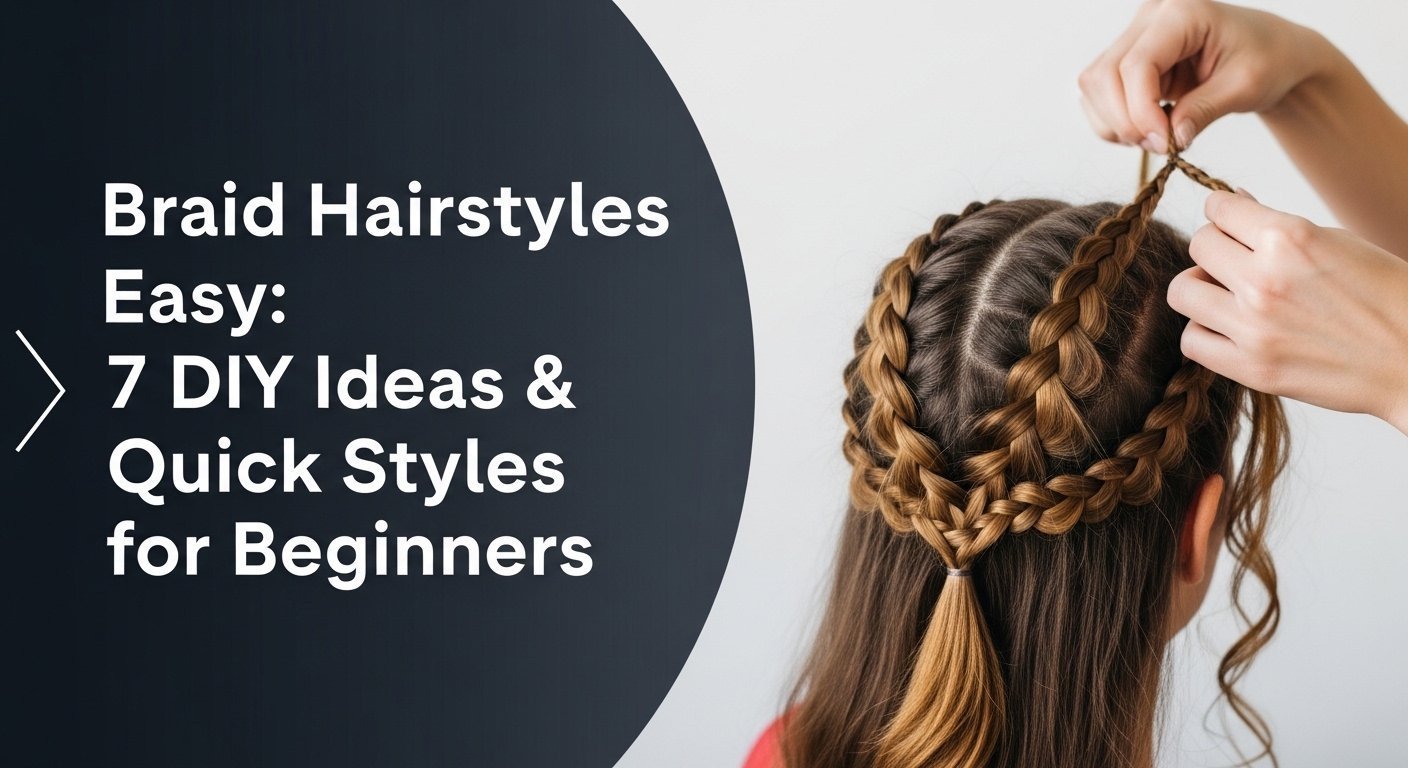
Does braiding your own hair feel like an impossible task? You watch endless tutorials, but your arms get tired and the final result is a frizzy, uneven mess. It’s frustrating when you’re just looking for simple, braid hairstyles easy enough to do yourself.
The easiest braids to do on yourself are the classic 3-strand braid, the simple rope braid, and the bubble braid. These styles require minimal hand-eye coordination and are foundational for learning more complex weaves, building muscle memory and confidence.
Drawing from tried and true methods, this guide breaks down the process into simple, achievable steps. We’ll move beyond confusing tutorials and focus on beginner-friendly braids you can master. In this post, you’ll discover 7 DIY braid ideas that are both quick and beautiful.
What Are the Easiest Braid Hairstyles to Do On Yourself?
Finding the right starting point is the most important step in learning how to braid your own hair. Many beginners jump straight to complex styles they see on social media, leading to arm fatigue and frustration. The key is to begin with styles that build foundational skills and muscle memory. These braids for beginners focus on simple hand movements and easy-to-manage sections. By mastering these, you create a solid base for tackling more intricate designs later on, turning an intimidating task into a fun and creative skill.
7 Easy DIY Braid Hairstyles for Beginners in 2026
Ready to finally master braiding? This step-by-step guide is designed for absolute beginners. We will walk through 7 distinct styles, from the most basic plait to beginner-friendly versions of classic looks. Each tutorial includes exactly what you need, clear instructions, and an expert tip to help you avoid common mistakes. This is your complete “braiding kit” to achieve real-life results at home.
1. Master the Classic 3-Strand Braid

Pin this foundational braid to your ‘Easy Hairstyles’ board!
Products & Tools Used
- A detangling brush to ensure hair is smooth and knot-free.
- A hair tie or clear elastic to secure the end.
- Optional: A light-hold hair spray to tame flyaways.
Application/Styling Steps
- Prep and brush your hair to remove all tangles.
- Separate your hair into three equal sections: left, middle, and right.
- Cross the right section over the middle section. The right section is now the new middle.
- Cross the left section over the new middle section. The left section is now the new middle.
- Repeat this pattern of crossing the outer sections over the center section until you reach the end of your hair.
- Secure the end with a hair tie.
Pro-Tip: For a neat braid, try to maintain even tension management as you weave. If your arms get tired, hold the three strands in one hand and take a short break. This is a common issue for beginners!

2. Create an Elegant Fishtail Braid

Save this elegant hairstyle idea for your next date night!
Products & Tools Used
- Clear hair elastics that are small and discreet.
- Optional: A texturizing spray to give hair more grip, especially if it’s fine or slippery.
Application/Styling Steps
- Separate your hair into two large, equal sections.
- Take a small, half-inch piece of hair from the outside of the right section.
- Cross this small piece over the top of the right section and join it with the left section.
- Take a small, half-inch piece from the outside of the left section.
- Cross this small piece over the top of the left section and join it with the right section.
- Repeat this weaving process, always taking a small piece from the outside of one section and crossing it over to the other.
- Continue down the length of your hair and secure with a clear elastic.
Lesson Learned: My braids always looked messy until I learned this trick: use smaller sections for a tighter, more intricate fishtail, and larger sections for a quicker, chunkier look. For a fuller look, gently pull on the edges of the finished braid.

3. Style a Quick & Trendy Bubble Braid

Pin this 5 minute braid hairstyle for a fun and easy look!
Products & Tools Used
- A detangling brush.
- Multiple hair ties (either clear or colorful for a fun look).
Application/Styling Steps
- Prep your hair by brushing it into a smooth high or low ponytail and secure it with a hair tie.
- Move down about two inches from the base of the ponytail and add another hair tie.
- Gently pull and tug on the section of hair between the two elastics to create a round “bubble.”
- Continue placing hair ties every few inches down the length of your ponytail.
- After placing each new elastic, pull the hair apart to create the next bubble.
- Repeat until you reach the end of your hair.
Pro-Tip: To get fuller, rounder bubbles, gently pull from the center of the section as well as the sides. This technique of structural integrity helps create that perfect sphere shape instead of a flat one.

4. Attempt the Beginner’s French Braid

Ready to level up? Save this beginner French braid tutorial for later!
Products & Tools Used
- A fine-toothed comb for creating neat parts.
- Sectioning clips to hold back hair you aren’t working with yet.
- A hair tie to secure the end.
Application/Styling Steps
- Section off a triangle of hair at your front hairline.
- Separate this section into three equal strands, just like a classic braid.
- Begin with one full stitch of a classic braid: right over middle, then left over middle.
- Now, before you cross the right section over again, gather a small, new piece of hair from the right side of your head and add it to that right section.
- Cross the combined right section over the middle.
- Before you cross the left section, gather a new piece of hair from the left side and add it to the left section.
- Cross the combined left section over the middle.
- Repeat this process of adding hair to your outer strands before crossing them over the middle. Once all hair is gathered, finish with a classic 3-strand braid.
Pro-Tip: Don’t look in the mirror! It reverses your movements and can be confusing. Practice by feel first. For better parting precision, use the end of a rattail comb to create clean lines when gathering new hair.

5. Achieve the “Pop-Out” Dutch Braid

Pin this bold Dutch braid style to try this weekend!
Products & Tools Used
- A comb for parting.
- Hair ties.
- Optional: Edge control product for a super neat hairline, especially for natural hair.
Application/Styling Steps
- Start exactly like a French braid: take a section of hair at your hairline and separate it into three strands.
- Here’s the key difference: instead of crossing the outer strands over the middle, you will cross them under.
- Cross the right section under the middle section.
- Cross the left section under the middle section.
- Now, begin adding hair. Gather a new piece of hair from the right side and add it to your right strand.
- Cross the combined right strand under the middle.
- Gather a new piece from the left, add it to the left strand, and cross it under the middle.
- Repeat this “adding and crossing under” pattern down your head.
Pro-Tip: The Dutch braid is the foundation for the iconic box braids style. Mastering this “under” technique is a key skill. To make the braid look even bigger and more dramatic, gently tug on the outer edges (this is called “pancaking”).

6. Weave a Simple Side Braid

Your new go-to everyday hairstyle! Pin this for later.
Products & Tools Used
- A brush.
- A hair tie.
- Bobby pins that match your hair color.
Application/Styling Steps
- Prep your hair by brushing it all over to one side of your head (left or right).
- You can do any braid you like from here: a classic 3-strand, a fishtail, or even a rope braid. We’ll use the classic for this example.
- Separate the hair into three sections.
- Weave a standard 3-strand braid down the length of your hair.
- Secure the end with a hair tie.
- For any short hairs that fall out at the back of your neck, use bobby pins to discreetly tuck and secure them.
Lesson Learned: If your braid feels too tight or severe, leave a few tendrils out around your face before you start braiding. This creates a softer, more romantic look and is a great solution for fixing messy braids by making the messiness look intentional.

7. Twist a 2-Strand Rope Braid in 2 Minutes

The fastest braid you’ll ever learn. Pin this time-saving hair hack!
Products & Tools Used
- A brush.
- A hair tie.
- A small amount of hair gel or smoothing serum to prevent frizz.
Application/Styling Steps
- Start with a ponytail. This makes learning much easier.
- Separate the ponytail into two equal sections.
- Twist both sections in the same direction. For example, twist them both tightly to the right.
- Now, cross the two twisted sections over each other in the opposite direction. So, if you twisted them to the right, you will cross them over each other to the left.
- Continue twisting the individual sections right while crossing them over each other left until you reach the end.
- Secure tightly with a hair tie.
Pro-Tip: The secret to a rope braid that doesn’t unravel is the opposing tension. You MUST twist the individual strands in one direction and wrap them around each other in the opposite direction. This interlocking method is what creates a stable structure.

Key Takeaways
- Start with the Basics: Master the classic 3-strand braid first. It’s the foundation for almost every other braid and builds essential muscle memory for braiding your own hair.
- Two Sections for Elegance: A Fishtail Braid looks incredibly intricate but only uses two main strands. The secret is to consistently take small pieces from the outside and cross them over.
- “Under” Creates “Pop”: The only difference between a French vs Dutch braid is the direction of the weave. Weaving under makes the braid pop out for a bold, 3D look.
- Twist in Opposite Directions: For a rope braid that doesn’t unravel, you must twist the individual strands in one direction (e.g., to the right) and then wrap them around each other in the opposite direction (to the left).
- Prep is Everything: No braid will look neat on tangled hair. Always start by using a detangling brush and, for advanced styles, use a comb for parting precision.
FAQs About braid hairstyles easy
What are the easiest braids to do on yourself?
The absolute easiest braids for a beginner are the classic 3-strand braid, the 2-strand rope braid, and the bubble braid. These require the least complex hand movements. The 3-strand braid is the foundation of all weaving, the rope braid is a simple twist, and the bubble braid requires no weaving at all, just hair elastics.
Why do my braids look messy?
Your braids might look messy due to uneven sections, inconsistent tension, or stray flyaways. To fix this, focus on parting precision—make your three initial strands as equal as possible. Try to pull with the same amount of pressure for each stitch. A small amount of gel or smoothing cream can help tame flyaways.
Can you braid wet hair?
Yes, you can braid wet hair, and it often results in a tighter, neater braid that leaves beautiful waves when it dries. However, be gentle, as wet hair is more fragile and prone to breakage. It’s not recommended for very tight styles that can cause too much tension on the scalp.
How do I prepare my hair for braiding?
Proper hair prep is key for neat, long-lasting braids. Start by thoroughly washing and conditioning your hair. Then, apply a leave-in conditioner or moisturizer. Most importantly, detangle your hair completely until a brush or comb can pass through it smoothly without any knots.
What’s the difference between a French and a Dutch braid?
The only difference is the direction you weave: French braids go over, and Dutch braids go under. In a French braid, you cross the outer strands over the middle strand. In a Dutch braid, you cross the outer strands under the middle strand. This simple change makes the Dutch braid “pop” out from the head.
How can I braid short hair easily?
For short hair, start the braid closer to the scalp and pick up smaller sections of new hair. A French or Dutch braid works well if you have enough length to grip. If your hair is too short to braid, try simple twists along the hairline secured with bobby pins for a similar look.
How do I keep my braids from getting frizzy?
To prevent frizz, start with a moisturizing product and consider a light-hold gel or pomade for control. Sleep on a silk or satin pillowcase or wear a silk bonnet at night to reduce friction. You can also lightly spritz your braids with an anti-frizz spray.
Is it hard to braid your own hair?
It can be challenging at first due to arm fatigue and awkward angles, but it is a learnable skill. Start with simple styles like a side braid where you can see what you’re doing. Practice the hand movements without a mirror to build muscle memory. Patience is key!
What do I need to start braiding?
For most simple braids, you only need a few basic items. The essentials are a good detangling brush, a comb for parting, and hair ties to secure the ends. As you advance, you might want sectioning clips, bobby pins, and styling products like edge control or hairspray.
How long do easy braids last?
A simple, loose braid may only last a day, while a tighter Dutch or French braid can last for 2-3 days. The longevity depends on your hair type, the tightness of the braid, and how you protect it while you sleep. Styles like box braids are designed to last for several weeks.
Final Thoughts on Your Braiding Journey
Learning to braid your own hair is a journey, not a destination. It’s a skill that takes patience and practice, but it’s incredibly rewarding. Don’t be discouraged by initial failures or messy braids. Every attempt builds your muscle memory. By starting with the 7 easy braid styles in this guide, you are building a strong foundation. Celebrate your progress, have fun with it, and soon you’ll be creating beautiful, quick braid hairstyles without a second thought.
Last update on 2026-03-13 / Affiliate links / Images from Amazon Product Advertising API


